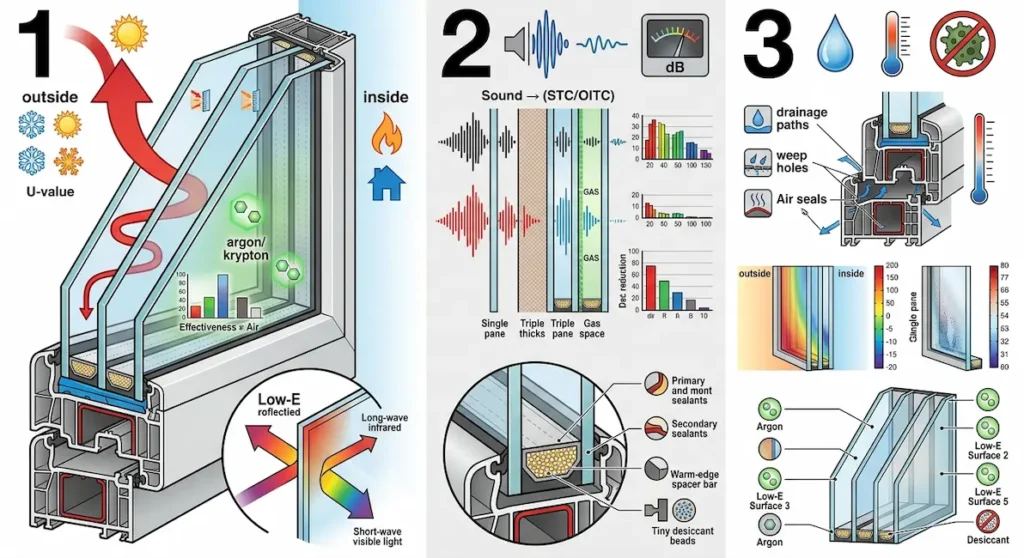
Many homeowners see triple-pane windows as a simple upgrade. In reality, the design is more advanced. That’s because triple-pane windows use three layers of glass to form two sealed insulating spaces. These spaces are filled with gas and paired with Low-E coatings, spacers, seals, and an insulated frame to manage how heat passes through your home window.
The number of panes shows how the insulated glass unit (IGU) is built, but it does not reveal the window’s U-factor, how much solar heat it lets in, its resistance to condensation, or how well the frame prevents heat loss.
Homeowners notice these engineering details as warmer glass in winter, steadier temperatures near big windows, less condensation, and lower heating or cooling needs. That’s why looking at the glazing, gas fill, spacer, frame, and window type as a whole system is vital, since these components ultimately affect how your window performs and how much energy (and bucks!) it saves your household.
What’s Inside a Triple-Pane Window?
A double-pane IGU has two glass layers and one sealed space. Triple-pane windows add a middle layer, creating two separate insulating spaces. These are usually filled with argon gas, but krypton is sometimes used for higher performance or in narrower spaces.
With three panes, there are six glass surfaces, counted from the outside in. Manufacturers can apply Low-E coatings to protected surfaces inside the sealed unit. This reduces radiant heat transfer and adjusts how much solar energy the window lets through.
A finished IGU depends on several parts working together: the panes, gas fills, Low-E coatings, spacers, and frame each play a role in how well your window insulates.
| Component | What it does | Why it matters |
| Three glazing layers | Create two insulating cavities | Adds thermal resistance across the opening |
| Argon or krypton | Replaces ordinary air between panes | Reduces heat transfer through the cavities |
| Low-E coatings | Reduce long-wave radiant heat transfer | Lowers U-factor and can control solar heat gain |
| Spacer system | Holds panes at the engineered distance | Affects edge-of-glass heat loss and condensation |
| Edge seals and desiccant | Keep gas in and moisture out | Protect long-term IGU performance |
| Frame and sash | Support the IGU and surround its perimeter | Can strengthen or weaken whole-window performance |
Case Study: What Can a Triple-Pane Window Actually Save?
A high-performance triple-pane window can insulate about 55% better or more than an older double-pane window, depending on the specific products.
For example, Berkeley Lab reports that double-pane glazing has a U-value of about 0.30, while triple-pane glazing can reach 0.19. This means triple-pane windows can improve insulation by around 60%.
Consider standard 3-by-5-foot single-hung windows, with a total area of 15 square feet. According to DOE modeling for cold climates, an older clear double-pane window has a U-value of about 0.52, while a high-performance triple-pane window has a U-value of about 0.20.
For that one opening:
- Old double-pane window: U-0.52
- Triple-pane replacement: U-0.20
- Reduction in conductive heat transfer: about 62%
- Window area: 15 ft²
This does not mean your heating bill will drop by 62%. Other factors like walls, roof insulation, air leaks, HVAC efficiency, sunlight, climate, and the rest of your windows also affect your home’s energy use.
Replacing Windows Saves More!
You’ll see bigger savings by replacing inefficient windows throughout your home. According to ENERGY STAR, swapping out old single-pane windows for ENERGY STAR-certified ones can lower your total energy bills by up to 13%. For a typical 2,376-square-foot U.S. home, that’s about $493 to $568 in annual savings, depending on your climate zone.
Triple-pane windows can achieve much lower U-factors than the minimum ENERGY STAR requires. Their main benefits are lower heat loss, warmer interior glass, better comfort, and long-term energy savings, rather than a big payback from just one window.
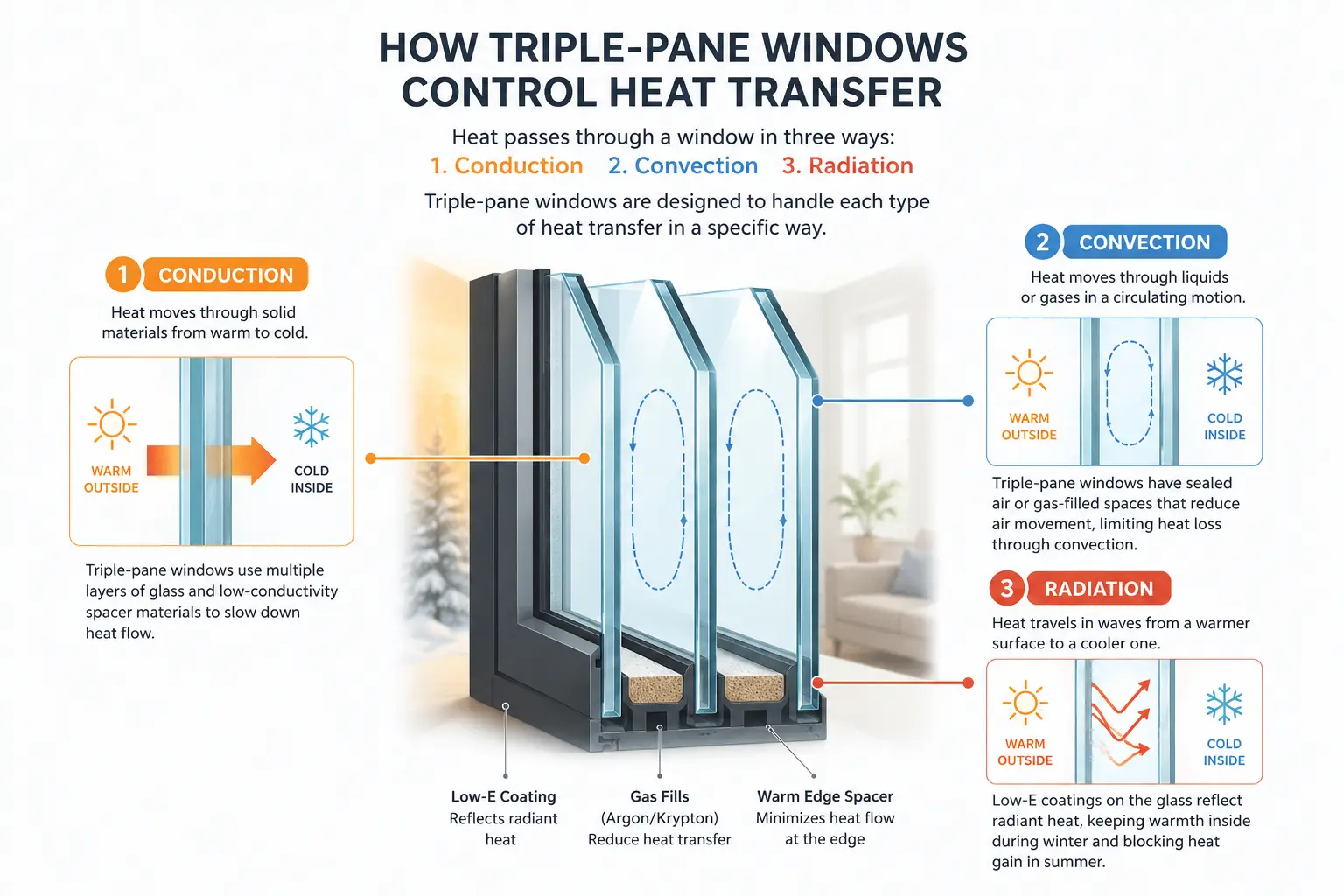
How Triple Glazing Controls Heat Transfer
Heat passes through a window in three ways:
- Conduction
- Convection
- Radiation
Triple-pane windows are designed to handle each type of heat transfer in a specific way.
Conduction
Heat moves through solid parts and the gas between the panes. Argon and krypton let less heat through than regular air. Heat-resistant frames and warm-edge spacers also help reduce heat loss around the glass.
Convection
The gas in each space changes temperature and moves around. Warm gas rises and cool gas sinks, creating a small loop. The cavity size and gas type are chosen to minimize this movement.
Radiation
Warm glass gives off infrared energy toward cooler surfaces. Low-E coatings help by reducing how much of this energy the glass emits.
Low-E technology matters because a sealed gas space alone cannot block radiant heat. Lawrence Berkeley National Laboratory says Low-E coatings let visible light through but reflect infrared energy, which helps reduce radiant heat flow through the window.
So, a triple-pane window acts more like a system that resists heat flow than just a pile of glass layers. The spaces slow down conduction and convection, Low-E coatings cut down on radiation, and the spacer and frame manage heat around the edges.
Why Gas Fill, Low-E Glass, and Spacers Matter as Much as the Third Pane
Adding a third pane sets up the window for better performance, but the details of the other parts decide how much improvement you actually get.
Gas fill
Argon is inert, clear, non-toxic, and relatively inexpensive. It is the standard choice for many double- and triple-pane residential windows. Krypton provides better insulation in narrow cavities and is particularly useful in thin-triple systems.
A pricier gas does not always mean better performance. The cavity width needs to match the gas’s insulating qualities.
Low-E coating
Low-E coatings lower radiant heat transfer, but they also affect how much solar heat and visible light come through the window.
DOE separates Low-E products into high-, moderate-, and low-solar-gain configurations. Lower-SHGC glazing can reduce cooling loads where solar exposure is a problem, while higher-solar-gain glazing may be useful in heating-dominated climates where winter solar heat is desirable. Orientation, exterior shading, window area, and climate all affect the appropriate choice.
This makes a major difference in real homes. For example, a big west-facing window that gets strong afternoon sun might need a different Low-E coating than a shaded north-facing window, even if both have triple glazing.
Spacer system
The middle of an IGU usually insulates better than the edges. The spacer forms a ring around the glass, and if it is made from a material that conducts heat easily, it can let heat escape at the edges.
Warm-edge and non-metal spacers help cut down heat loss at the edges and keep the inside edge of the glass warmer. The DOE recommends using warm-edge spacers to lower the window’s U-factor and reduce condensation at the edges.
In smaller windows, the edge effect matters more because the frame and edges make up a bigger part of the window’s total area.
The Number That Matters Is the Whole-Window U-Factor
Even a well-designed IGU can result in a window that does not perform well overall. The reason is simple: center-of-glass performance excludes the frame and edge conditions. The finished window also contains the sash, spacer, reinforcement, weatherstripping, and frame.
The NFRC Consumer Guide specifically warns that center-of-glass values should be used to compare glazing systems rather than complete window products because frame choice can substantially change performance.
That is why homeowners should check for the NFRC-certified rating for the entire window, not just the glass. NFRC currently evaluates residential fenestration using several performance metrics:
- U-factor: How readily non-solar heat passes through the complete window. Lower is better for insulation.
- Solar Heat Gain Coefficient, or SHGC: The fraction of solar heat admitted through the window. Lower values block more solar heat.
- Visible Transmittance, or VT: How much visible daylight passes through the product.
- Condensation performance: Indicates how resistant the product is to interior condensation under standardized conditions.
- Air leakage: Measures air passing through the window assembly.
The frame makes a big difference. According to NFRC, the sash and frame can make up 10% to 30% of the window’s area, so their insulation affects the final U-factor and is not just a small detail.
No universal U-factor defines every triple-pane window. High-performance thin-triple systems tested by Pacific Northwest National Laboratory have reached approximately U-0.20, or R-5 whole-window performance, using thin center glass, two Low-E coatings, and krypton-filled cavities. That figure describes a specific engineered system, not every three-pane product.
When comparing quotes, the key question is not “Is this triple-pane?” but “What is the certified whole-window U-factor for this specific window?”
What Better Window Engineering Feels Like Inside the Room
U-factor is a technical measurement, but homeowners feel its impact as the temperature of the window’s inside surface.
On a cold day, the inside surface of a poorly insulated window can be much colder than the walls or indoor air. If you sit next to it, you lose heat to the cold glass. The air near the window also cools and sinks, which can feel like a draft even if the window is not leaking air.
A well-insulated standard triple-pane sliding window keeps the inside glass warmer. This can make rooms more comfortable, especially if you spend time near big windows, patio doors, dining tables, or desks.
Studies on thin triple-pane windows found that they kept temperatures more even near windows and throughout homes, lowered the chance of condensation, and made people more comfortable than double-pane windows.
Condensation risk changes too
Condensation forms inside when the glass gets colder than the indoor air’s dew point. Keeping the inside glass warmer helps prevent this. Triple glazing cannot guarantee condensation-free windows. Risk still depends on:
- Indoor Relative Humidity
- Outdoor Temperature
- Frame And Spacer Performance
- Airflow Around The Window
- Window Coverings
- Installation Quality
Even with high-performance glass, a bathroom with high humidity during very cold weather can still get moisture on the windows.
Another useful distinction: condensation between the panes is a different problem. Fog or moisture trapped inside a sealed IGU usually indicates that the edge seal has allowed moisture into the cavity.
Lawrence Berkeley National Laboratory notes that desiccant inside the spacer absorbs small amounts of residual moisture, but once seal leakage exceeds its capacity, internal fogging can occur, and the sealed glass unit may need replacement.
Energy savings depend heavily on the starting point
Triple-pane windows cut down on heat loss, but it is not accurate to promise the same percentage of energy savings for every home.
In PNNL’s Lab Homes study, thin-triple windows were tested against double-pane metal-framed windows. Over two 10-week periods, the home with triple-pane windows used about 12% less heating energy and 28% less cooling energy.
These results depend on the specific buildings, climate, and test setup, so you should not expect the same savings if you are replacing modern double-pane Low-E windows.
Your windows’ condition, glass area, climate, window direction, air leaks, HVAC efficiency, and wall and roof insulation all affect the outcome.
Ready to Choose the Right Triple-Pane Windows?
Get in touch with our experts today to find the perfect energy-efficient glazing solution for your project.
The Engineering Tradeoffs of Adding a Third Pane
Better insulation also means some physical changes. Standard triple-pane windows have more glass, deeper cavities, and weigh more.
Some recent builder studies found that regular triple-pane windows can be 25% to 50% heavier than similar double-pane windows. This extra weight affects shipping and installation, and it can also matter once the window is in place. This extra weight is especially important for windows that open and close.
For example, a large triple-glazed casement places additional loads on:
- Hinges And Operators
- Sash Corners And Reinforcement
- Balances In Hung Windows
- Rollers In Sliding Systems
- Frame Connections
- Installation Fasteners
Because of this, manufacturers set limits on the size of each window and sash based on their tested designs. If an opening is too large, it may need to be split into smaller windows or include a fixed section instead of one large opening window.
Frame depth can complicate retrofit work
Traditional triple-pane IGUs are thicker than standard double-pane units, so they may need deeper frames and glazing pockets. In replacement projects, this can change the trim, drywall edges, outside siding, and how much glass you see.
PNNL has specifically identified retrofit situations where thicker replacement frames reduce the clear opening and may even affect whether an existing egress opening still provides the required net free area.
Thin-triple glazing addresses part of the problem
Thin-triple technology replaces the conventional center pane with ultra-thin glass. Sych systems use center panes approximately 0.7 to 1.6 mm thick, two Low-E coatings, krypton, and narrow cavities to reach about U-0.20 performance while remaining close to standard double-pane IGU dimensions.
This lets some manufacturers install high-performance triple glazing in frames originally made for double-pane windows.
More glazing can change daylight and appearance
Adding another pane and more Low-E coatings can lower the amount of visible light that passes through. This is an example closely related to sustainable and green architecture. The coating type can also change how the window looks from outside or add a slight color tint.
For small windows, these changes may be hard to see. On a large wall of glass, you should consider daylight, SHGC, outside appearance, and insulation together.
How Long Does the Insulated Glass System Keep Working?
The gas and coatings inside a triple-pane IGU do not need much care from homeowners because they are sealed in. The edge seal is the part most likely to have problems.
A spacer assembly has several jobs simultaneously. It must maintain cavity dimensions, accommodate thermal movement and pressure changes, limit gas diffusion, and stop moisture from reaching the protected surfaces inside the IGU.
Good-quality units slowly lose a small amount of gas over time. NFRC says well-made IGUs lose less than 1% of their gas each year, so insulation drops only slightly. But if the seal fails, gas can escape much faster, and moisture can get in.
Signs worth investigating include:
- Persistent Fogging Or Moisture Between The Panes
- Staining Inside The Sealed Cavity
- Visible Deterioration Around The Igu Edge
Condensation on the inside surface does not always mean the seal has failed. Moisture between the panes is a clearer sign of a problem. This is why it is important to check the IGU warranty and certified durability, not just the U-factor.
How to Compare Triple-Pane Windows Before You Buy
Window specs should fit your building, climate, window size, and reason for upgrading. For example, if you want more comfort in winter, you might need a different glass package than someone who wants to block afternoon sun or reduce noise. Before approving a triple-pane window quote, check these items:
- Whole-window U-factor: Ask for the NFRC-certified value for the actual product configuration.
- SHGC: Confirm that the solar-gain level makes sense for the climate, orientation, shading, and glazing area.
- Low-E package: Find out which coating is being used rather than accepting “Low-E” as a complete specification.
- Gas fill: Check whether the cavities contain argon or krypton and whether the cavity design is intended for that gas.
- Spacer system: Look for a low-conductivity or warm-edge design.
- Frame construction: The frame should support the glazing’s thermal performance rather than undermine it.
- Air leakage: Evaluate airtightness separately from U-factor, particularly for operable units.
- Condensation rating: Pay extra attention in cold climates or homes with higher indoor humidity.
- Maximum sash size: Confirm that the exact window dimensions and operating style are approved with the specified triple glazing.
- Acoustic data: If noise control is a priority, request STC or OITC performance for the actual assembly.
Noise control needs special attention. Triple glazing can reduce outside noise, but three panes alone do not guarantee good sound performance. Some tests showed 8 to 10 dB less noise, but results depend on pane thickness, cavity size, laminated glass, frame tightness, and installation quality.
For replacement windows, installation matters as much as the glass. Gaps, poor air sealing, bad shimming, or a bent frame can hurt comfort and performance, even if the window has a great lab rating.
The third pane adds another insulating space, but top performance comes from the whole window working together. When comparing products, look for a low whole-window U-factor, the right SHGC, a strong edge seal, a well-insulated frame, and installation that fits your opening. This is a better way to judge triple-pane windows than just counting the glass layers.
Wrapping Up
Triple-pane windows work well because each part is designed to manage heat flow. The third pane adds another insulating space, and the gas fill, Low-E coatings, warm-edge spacers, seals, and frame all help that extra layer work better.
Homeowners can see real benefits like warmer inside glass, more comfort near big windows, less condensation, and lower heating or cooling needs. These benefits depend on your climate, window direction, size, current windows, and how well the new ones are installed.
The best way to compare windows is to look past the “double or triple” label. Check the certified whole-window U-factor, SHGC, frame type, spacer, gas fill, air leakage, and any sound ratings that matter for your project. For big or opening windows, make sure the sash size and hardware can handle the extra weight.
A well-designed triple-pane window is a full building system, not just a window with an extra layer of glass. Book a consultation session with the Designing Drafting team and get more expert insights about triple-pane windows.
FAQs
Are triple-pane windows more energy efficient than double-pane windows?
Yes, but how much more efficient they are depends on the whole window, not just the glass. Top triple-pane windows can reach about U-0.19, while standard double-pane windows are around U-0.30. The exact rating depends on the glass, frame, spacer, and gas fill. A lower U-factor means the window lets less heat through.
Are triple-pane windows worth the extra cost?
Triple-pane windows are usually best for cold or mixed climates, homes with old or drafty windows, rooms with lots of glass, or places where staying warm in winter matters most. How much energy you save depends on your house. Different tests show that triple-pane windows warmed areas near windows and reduced heating and cooling needs compared to double-pane windows.
Do triple-pane windows prevent condensation?
Triple-pane windows can lower the chance of condensation inside, but they cannot promise your glass will always stay clear. They keep the inside surface warmer, so it is less likely to get cold enough for moisture to form. On average, thin triple-pane windows cause less condensation. Still, things like indoor humidity, outdoor temperature, spacer and frame design, and installation all play a role.
Are triple-pane windows better for noise reduction?
Triple-pane windows can help block outside noise, but the number of panes isn’t the only factor. Thin triple-pane windows can cut noise by about 8 to 10 dB compared to regular windows. Other factors like pane thickness, glass type, the space between panes, frame airtightness, and installation also affect noise reduction. Homeowners should check the STC or OITC ratings for the specific window they are considering.